
A new way to run an HF / VHF / UHF station
Traditional radio link two stations. A cluster links every band.
Tradional radio based data communcation systems supports a link between two stations, and only while both can hear each other on the same frequency. When a band closes at one end, the link is gone. A three-way (or more) chat over HF was simply not possible.
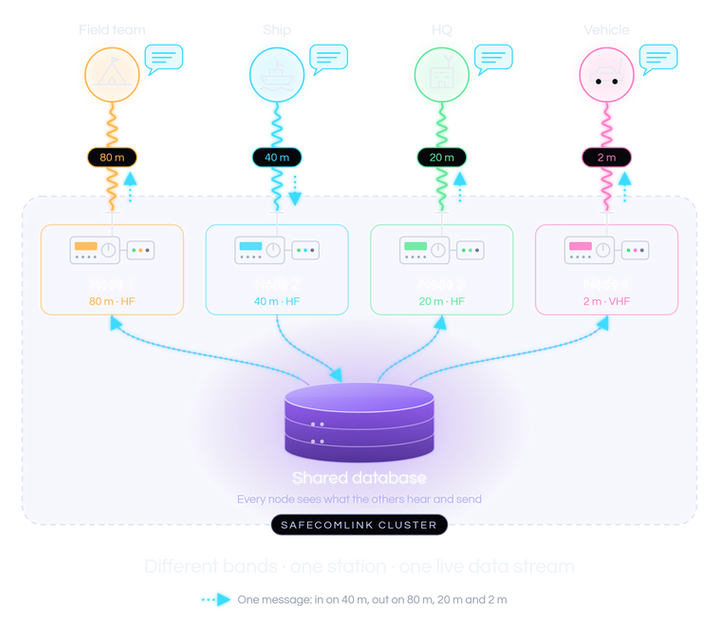
A SafecomLink Cluster runs several nodes, each with its own transceiver and modem, on top of one shared database. Every node knows what the others are hearing and sending, so data that comes in on one band goes straight back out on another. Different bands, one station, one live data stream.
How a cluster compares to a standard radio station
One radio means one band and one partner. A cluster has neither limit.
Setup
Bands at once
Stations per chat
Single station
One radio, one modem
One band
Two stations only
Band closes: The link drops
SafecomLink Cluster
One per node, no limit
Three or more, live
Band closes: Traffic reroutes
Two layers, always running
Each node handles its own radio. The shared database ties them together, so the whole station behaves as one.
Put a radio on every band you need
1
Deploy nodes
Connect each transceiver and modem to its own SafecomLink node, for example one on 20 m and one on 40 m.
2
Share one database
All nodes read and write the same SafecomLink database, so each one knows the others' traffic and state.
3
Watch it from one screen
The cluster dashboard shows every node's band, mode and status. Last Heard groups stations by the node that heard them.

Safecomlink Cluster view
Read the case study
See how a SafecomLink Cluster bridges Pactor ARQ links across bands, and how three or more stations hold a live, error-free chat over HF for the first time.
Why it matters in the field
Built for operations where propagation shifts by the hour and not every station can reach the same band.
Bridges stations with no shared path
A station in Europe with 20 m into the Middle East and a station in North America with only 40 m can talk in real time through a cluster between them.
One hub for the whole operation
An emergency operations center can run 80 m for local NVIS traffic and 40 m for regional, and every field team trades data with every other, whatever band it came in on.
Ship to shore, band to band
A vessel on 15 m or 10 m links to a coastal cluster, and its messages go straight on to inland teams working 40 m or 80 m.