
A paradigm shift in HF
Legacy ALE guesses. 5G AI-ALE knows.
For decades, HF radios established links by blindly scanning frequencies or leaning on fragile external crutches, GPS time sync, or internet-hosted ionospheric models. The moment those crutches are jammed or cut, the link dies.
SafecomLink 5G AI-ALE throws out the theory. Each node continuously maps its own real-world RF environment and uses machine learning to predict the best frequency for every link — locally, autonomously, and completely off-grid.Real spectrum. Real intelligence. Zero dependencies.
How 5G AI-ALE compares to every ALE generation before it
From blind 2G scanning to GPS-dependent 3G, every legacy approach carries a single point of failure. 5G AI-ALE has none.
Generation / Protocol
Synchronization
Propagation data source
Vulnerability / dependency
2G ALE
MIL-STD-188-141A/B
None (asynchronous)
None. Blind random scanning
Slow link establishment
3G ALE
MIL-STD-188-141A/C
STANAG 4538
Synchronous
GPS time-sync required
GPS jamming halts sync
SafecomLink 5G AI-ALE
Autonomous / local
Real-world spectrum mapping via AI
None — true off-grid
Two phases, always running
5G AI-ALE continuously interleaves environmental mapping with intelligent link establishment, so by the time you make a call, the answer is already known.
PHASE I · Real-world data capture & channel mapping
Build an empirical, localized RF map in real time
1
Continuous spectrum scanning
All nodes cycle through a mutually agreed frequency list, listening across the band.
2
Autonomous beaconing
Every station transmits a low-overhead identifiable handshake beacon at configurable intervals.
3
AI-driven matrix generation
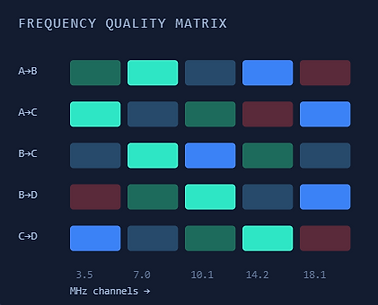
The local AI analyzes SNR, BER and multipath fading to build a dynamic Frequency Quality Matrix per link.
PHASE II · Link establishment & dynamic handover
Skip blind scanning, target the winning channel first
1
Predictive prioritization
The AI ranks channels from highest to lowest probability of success using live local data.
2
Targeted execution
The transceiver calls down the ranked list, hitting the best channel first, slashing handshake time.
3
Live optimization & handover
If link quality drops below threshold, the AI seamlessly switches to the next best frequency without dropping the session.
Read the white paper
Discover how integrating 5G-AI-ALE directly into the data communication protocol enables channel-aware frequency selection that conventional ALE solutions cannot match.

Why it matters in the field
Designed for contested, jammed and deeply degraded environments where legacy ALE simply stops working.
True EW resilience & off-grid autonomy
No GPS sync, no internet space-weather feeds. Eliminating 3G's primary vulnerabilities, the system stays fully operational in jammed or denied environments.
First-time-right connection efficiency
AI-predicted first choices replace blind scanning, minimizing on-air footprint and handshake latency and lowering probability of intercept and detection (LPI/LPD).
Active session
persistence
Legacy systems wait for a link to fail before re-scanning. 5G AI-ALE hops predictively during the live session, maintaining link integrity seamlessly.